| 3.3.
Stream Production
Habitat biologists use the word production when they
talk about streams because they think about the habitat
in a stream as a kind of factory where fish can be produced.
So when they talk about the biological production they
generally mean how many fish can be found or "produced"
in streams.
How well a stream "produces" is a combination of many
factors. When we try to improve or enhance habitat,
as in the Adopt-a-Stream program we are also trying
to improve stream production.
The vegetation growing alongside the stream has a strong
influence on production because the habitat provided
in a stream is tightly linked to its surroundings. Small
streams in forested regions receive much of their materials
from the surrounding forest ecosystem. Needle and leaf
debris, twigs and branches are the main sources of nutrients
to feed plants and animals in the stream.
There are two important food chains related to streams.
The first (sometimes called the Internal Pathway or
autochthonous) is based on what is produced in the stream
through algae on the rocks and wood in the stream via
photosynthesis. The required inputs to make this work
are the "correct" mix of chemicals, nutrients and sunlight.
It is this layer of algae on the rocks that often makes
the stream slippery for wading anglers. However, in
most shaded, woodland streams the amount of sunlight
reaching the stream is small and limits algal production.
Typically, the most stable streams have the best development
of algae, since the suspended sediments in freshets
scour the stream bottoms and remove algae growths in
less stable watercourses. Algal growth is used in either
its live or decomposed state by invertebrates (usually
immature insects) which in turn are preyed upon by other
species. These insects are the basic food for fish.
Because of their low organic retention and their greater
light interception, larger streams depend primarily
on in stream production of this algae as a food source.
The second important food chain (sometimes called the
External Pathway or allochthonous) is based on what
is produced in the forests and is dependent on plant
material from streamside vegetation entering the stream.
There is actually a steady drop of plant material from
land into the stream throughout the year, but the vast
majority falls in the autumn when large amounts of leaves,
small twigs, etc., become incorporated in the stream
bottom. There the material begins the relatively slow
process of decomposition through the action of fungi
and bacteria. This material is colonized by microbes
and is then consumed by stream invertebrates (mainly
insects), which are in turn prey for carnivorous invertebrates
and fish.
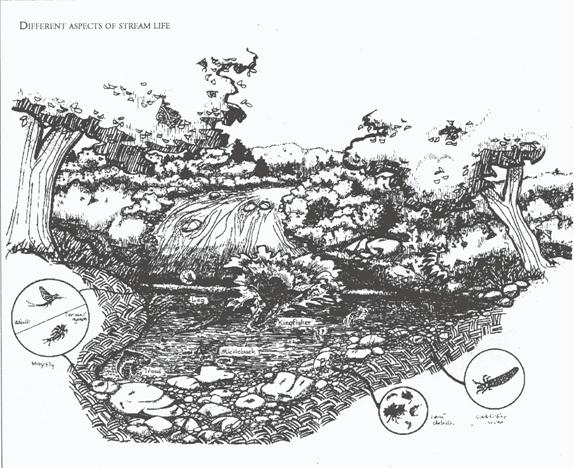
This illustration is one example of some of the different
aspects of stream life |