| 3.4.
Insects and Their Life History
Because of the importance of food for fish it is important
for you to understand a little about insects and how
they live. Looking for insects is one of things you
will be doing when you survey your watercourse. As food
for so many fish and other animals, the presence or
absence of insects are important indicators of stream
health.
Many insects use the water for the early stages of their
lives. Winged adults can often be seen flying above
or resting on the stream vegetation and water, but it
is beneath the surface of the water, among the rocks
and stones, that the real abundance of insects occurs
in immature forms.
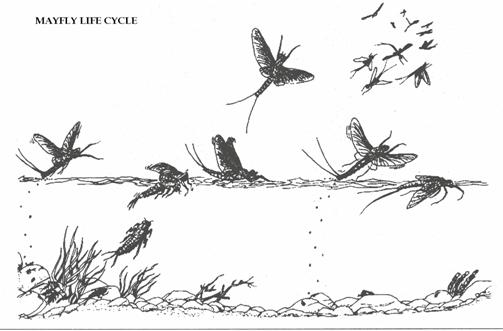
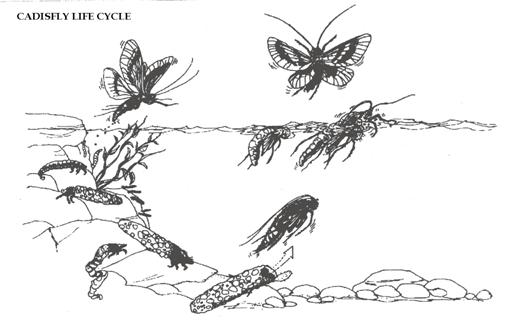
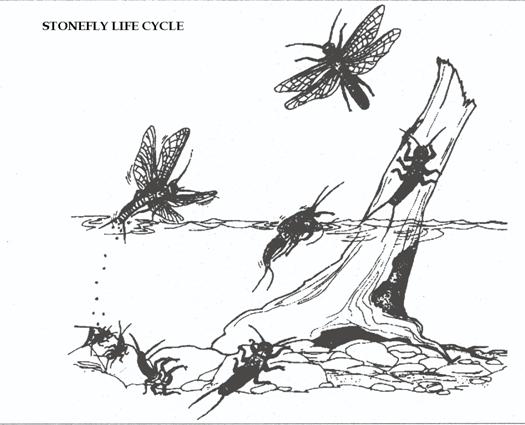
The adult female of aquatic insects lays her eggs in or on the water. Then the insect life cycle follows one of the two patterns:
1. In forms with simple life cycles, eggs hatch into
"nymphs". These can be somewhat like adults except they
lack wings,
2. In forms with complex life-cycles, the eggs hatch
into "larvae", a grub like form of life. After a period
of feeding, a mature larvae develops into a pupa (a
resting stage during which the adult structures, most
noticeably the wing pads on the back of the thorax,
develop).
Both larvae and nymphs are voracious feeders. Some clamber about the bottom of the stream browsing on plant material, some prey on other animals, and others remain fixed in one place getting their food from water by means of intricate filtering mechanisms. Growth is by molting, a shedding of the body-covering to allow for enlargement. As maturity approaches, the pupa or mature nymph ascends to the water surface or walks ashore to allow the adult to emerge. During this phase it becomes very vulnerable to foraging fish. After emergence, the adult rests for a time to allow its wings to harden before flying off. Mating on the water takes place in the adult phase, completing the cycle.
Immature stages of aquatic insects occur on or under the water, but only the true bugs (Hemiptera) and the beetles (Coleoptera) have aquatic adults. In the other major groups of aquatic insects, the adults live on land, usually remaining close to the stream. They can often be seen in mating swarms or laying eggs on the water surface. The adult stage is mainly a reproductive phase; many adults are short lived and most do not feed.
Important examples of aquatic insects with simple life-cycles
are stoneflies (Plecoptera) and mayflies (Ephemeroptera).
Complex life cycle types include the true flies (Diptera)
and Caddis flies (Trichoptera).
Aquatic insects occur in all bodies of fresh water,
from stagnant pools to the largest lakes, from the smallest
trickle to the fastest rivers. A typical stream suitable
for trout and salmon is roughly composed of two alternating
and contrasting habitats: the riffle and the pool (described
earlier). Riffles, where the water is shallow and fast,
contain gravel with a lot of oxygen. This gravel offers
favourable spaces for many animals, and it is here that
most of the stream insects occur. Diatoms (minute green
plant cells), a principal food of herbivorous larvae
and nymphs, grow on the tops of stones in these rapid
sections. Fast currents also carry minute particles
of food to insects such as black fly larvae and the
net spinning caddis, which feed by filtering mechanisms.
The three illustrations on the following pages show the life cycles of the caddis fly, mayfly, and the stonefly.
|