|
| 3.2.
Stream Habitat
Streams, of course, are habitats to many other forms
of life other than fish. Plants, small insects and invertebrates,
and small mammals live and use the water. The areas
around streams, called riparian habitat, are very important
to a whole host of plants and animals.
In the section called Facts on Fish we will discuss
what kind of stream habitat a fish requires. Birds and
animals congregate around streams. One reason this occurs
is that all animals need a source of water. Many animals
either eat the fish or insects or the plants growing
in and around streams. The areas along streams are also
commonly used for travel, nesting, and shelter. If you
walk along the sheltered edge of a stream in winter
you will see many animal tracks and deer beds in the
snow.
Adopting a stream means you are also adopting the area
around the stream, all the animals that use the stream,
and its riparian zone.
In addition to improving fish habitat you may want to
consider putting up nest boxes for birds (see Section
Where to Go For Help). Local naturalists, birding clubs,
or the regional biologist from the Department of Natural
Resources may have other ideas on how to improve the
area around the stream. The habitat potential of a stream
is created by many different factors.
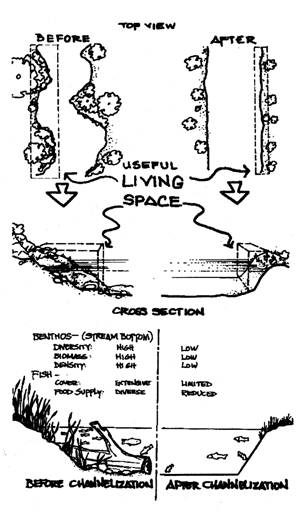
3.2.1 In-stream Cover
In-stream cover is generally provided in five ways:
|
|
- Undercut Banks: where water
has eroded away the material under a stream bank. The
upper portion has not slipped into the water because
the root systems of trees, shrubs, and other vegetation
have held the soil.
- Rocks, stones and boulders found in streams provide
protection from predators, weather, and other factors.
The size of a rock, its shape and location, all have
an influence on what uses it for cover. Irregular rocks
and boulders as well as slab sided boulders with no
sand or silt under them, provide the best cover for
juvenile fishes.
- Logs and trees. These are essential in streams to
assist in developing pools, cleaning the bottom, and
stabilizing the stream. The proper amount of large material
can make the difference between poor and excellent fish
habitat in many streams. Logs and stumps also provide
overhead cover as an escape from predators or fast flowing
water. However, too much of a good thing can be bad.
Log jams, which cause water to be diverted over the
stream banks, can cause severe erosion and may have
to be removed.
- Low overhanging grasses and bushes also provide overhead
cover under which fish can hide. This is particularly
important for trout.
- Water depth, water colour, and surface turbulence
also act to hide fish from land predators. The broken
water surface of riffles hides young salmon and the
deep water of pools hides trout. The quality of a pool
is determined by depth and how much of the bottom is
hidden by the cover features listed above
|
|
|
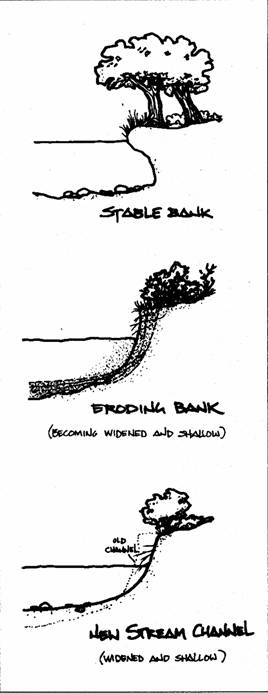
3.2.2 Bank Stability
Although erosion is a natural and dynamic process, human activities
often change the stability of a stream bank, causing increased
erosion. The stability of a bank gives an indication of how
much erosion is taking place. Excessive erosion produces silting
and encourages the stream to widen and become shallow. Banks
that are actively eroding will eventually cause a decrease in
the abundance of fish and invertebrates, such as insects. Stable
banks have little or no erosion, are not slumping, and usually
have growths of grasses, shrubs and trees. In some instances,
they have been stabilized previously by artificial means. The
impact on the stream of stable and eroding banks as illustrated.
3.2.3 Stream Canopy (Shading)
Shading affects life within the stream because many fish are sensitive to high temperatures. Shade keeps the air and water cool. The amount of shade depends on how many plants and trees are growing near the stream, the height of the trees, and the direction the stream is flowing (the direction is important because of where the sun is in relation to the trees. For example, a stream flowing in a north-south direction may have different amounts of sun than a stream flowing in an east-west direction. Trees overhanging the stream also provide nutrients (in the form of old fallen leaves) and food (insects dropping into the stream).
3.2.4 Stream Gradient or Slope
Stream gradient is the actual visual angle of descent or slope of the stream. Slope affects the speed of the water flow and how much of the stream will be pool or riffle. This directly affects the balance between salmon and trout and other species. For example, salmon prefer a 75:25 riffle - pool ratio while trout prefer a 50:50 ratio of pool to riffle.
3.2.5 Stream Chemistry
Nova Scotia's streams have poor levels of nutrients and minerals. This is expressed as low conductivity. To help compensate for this, leaves and litter that come from plants along the watercourse are very important, accounting for up to 90% of the food in a stream. Leaves from deciduous trees and bushes are the best
|
|
|
|
|
The chemistry of fresh water
is not nearly as complex as that of salt water. However,
some basic chemicals in fresh water should be mentioned.
The amount of dissolved oxygen gas is a vital requirement
for fish and insects living in water. Twenty percent
of the earth's atmosphere is oxygen. Land animals use
lungs to bring oxygen into their bodies. Many insects,
amphibian tadpoles, and all fish use gills to perform
the same function. The gills absorb oxygen from the
water and release waste gases back to the water, but
oxygen levels in the water are only 6 to 12 parts per
million, far less than the air. This means the oxygen
levels in water can be easily depleted. Oxygen dissolves
in water depending on water temperature. The colder
the water the more oxygen it can hold.
Acidity is another important component of stream chemistry.
The amount of acid in the water is measured on a 14-point
scale called the pH scale. Liquids like lemon juice,
vinegar and battery acid are all considered "acidic"
with a pH ranging from 0 - 7. Substances like baking
soda, milk of magnesia, ammonia, and lye are all alkaline
with a pH ranging from 7 -14. A pH of exactly 7 is neutral
(milk is an example of a neutral substance).
|
During stream surveys you will be asked to take water
samples to test for pH. The alkalinity of a water sample
refers to its ability to counter the effects of acid.
Alkalinity is mainly determined by the kind of rock base
that forms the streambed and the watershed.
|
Most stream life quickly
dies if the pH falls below 4.7. Vinegar has a pH of
3.0
|
Water also contains minerals such as calcium and magnesium,
which determines how "hard or soft" the water is. Other
nutrients found in the stream include phosphorus and nitrogen.
Usually when stream samples are taken, the water is also
examined for toxic amounts of copper, mercury, and other
metals.
3.2.6 Stream Temperature
The shape of the channel, shade, the air temperature,
the surrounding soil, the speed of the water flow, and
the water volume, control stream temperature. If the channel
is narrow and deep (with good pool development), it has
a large volume of water to heat up and cool down in comparison
to the water surface, so temperatures do not change much
over the day. If the channel is wide and shallow it will
heat and cool quickly. Following the air temperature.
Everyone knows it is cooler in the shade because there
is little or no direct sun. The amount of shade along
a stream affects the amount of direct sun that reaches
the water. Direct sun heats the dark coloured, unshaded
stream bottom, raising water temperatures. The shallower
the water, the more effect it has. Shallow streams have
water temperatures that follow the air temperature throughout
the day. This is because there is a relatively large surface
in contact with the air and a small volume of water.
Springs in the riparian area are important moderators
of temperature because groundwater temperature is usually
cool and stable. Water also seeps in and out of the stream
and these seeps can have an important influence on temperature.
If an area is cleared of vegetation (e.g. clear-cut, farm
field, or parking lot), the seeps heat up in the sun.
The cooler groundwater becomes hot.
In the winter the temperature situation is reversed. Shade
actually warms the stream temperature by moderating cold
winds and frigid temperatures. The vegetation also keeps
frost from getting into the ground so that springs and
seeps keep running longer in the winter and the stream
bottom resists freezing. A healthy stream keeps an open
passage under the snow and ice during low flow periods
in winter. This insulating layer provides over-winter
water for fish, prevents freezing of eggs, and keeps ice
formations to a minimum. Since there is less ice, there
is also less ice damage to the stream during the thaw
or spring break-up |
|
Streams fed by lakes are warmer because of the heating
effect of the sun on the open water. If the stream channel
is well developed and shaded, the water temperature
will drop to tolerable levels within a kilometer downstream
of the lake |
A healthy stream can maintain temperatures
within ideal ranges for fish throughout their growing
season. |
Tributaries that come into the stream, of course, can
affect the water quality and habitat. Try to identify
where and what kind of water is entering the stream you
are studying. |
|
|


|
|
|
|