|
3.1. How a Stream Works
The basic structure of a stream influences its health and ability to provide habitat. Stream structure is a balance of its soils, water table levels, and land elevations, creating a habitat that is unique with each stream. Understanding this balance is important: enhancement of habitat often corrects problems that occur when people tamper with its balance.
The structure of a stream is defined by:
- Water flow features (the stream's pools, riffles or other
specialized sections)
- Channel (the stream's width and shape)
Let's look at each one of these so we understand what they mean.
|
|
|
Water flow Features
The flow of a stream can be broken down into four main areas
- Riffles
- Pools
- Runs
- Flats
|
|
3.1.1
Waterflow Features
Riffles
These are the swift, shallow portions of streams or
rivers where the water surface is broken. Often rocks
protrude through the water surface. The stream bottom
is usually gravel and rock. Riffles are important areas
for two major reasons. Most of the food supply for salmon
or trout is produced on them and young salmon will establish
feeding territories here during the summer. Salmon that
are laying eggs (spawning) select areas where water
is seeping through the gravel. These areas are usually
found at the tail of a pool or at the head of a riffle.
Runs
These are swift, deep portions of streams or rivers.
Although water flow in a run may be as swift as in a
riffle, the water is deeper. Runs can range in depths
(depending on stream size) from 20 cm to 2 meters (8
in. to 6.6 ft.) deep. The stream bottom is usually rock
and boulder.
Pools
These are slow, deep portions of rivers and streams
(in proportion to the watercourse's size). Pools can
be of various depths, but are the deepest areas of a
stream. The bottom can be gravel, rock, boulder, silt
or log-strewn. Pools provide living areas for a variety
of fish. These slow, deep areas are a refuge in the
winter for many species of fish, and provide ideal cover
for some of the largest trout. Pools are critical habitat
for salmon during low flow periods in the summer and
winter, for the migration of adults as holding and resting
areas, for spawning adults holding areas and as winter
habitat for pre-smolts. During normal flows pools are
dominated by trout, and the size of the pool and available
instream cover, are the major determining factors on
how many, and how large a trout, can live there. The
largest numbers of speckled and brown trout are found
in pools.
Flats
These are the shallow, slow portions of streams, usually
located at a point where the watercourse widens. A flat
can be as shallow as a riffle, but is much slower-moving.
The pattern in which these four features occur depends
on the soil-type, vegetation, slope, and amount of water
flow. In most normal streams there is a sequence of
shallow to deep water over a section of river. Scientists
call this the riffle:pool ratio. In your watercourse
project you may need to balance the riffle:pool ratio.
Habitat biologists can help you determine whether this
is necessary and if so, how to do it.
|
| A healthy
river will have a mixture of the four physical features.
The manner in which they are mixed is unique for each
stream, creating its individual character and appeal.
|
A healthy stream
channel adjusts to change naturally without changing
its basic shape and form
|
3.1.2 Typical Stream
Channel Patterns
Gravity, friction, and depth
of flow are the three main forces that create stream channels.
- Gravity causes water to move downstream and gives it
speed, while friction between water and the streambed
and banks creates a turbulence that slows down the flow.
|
|
- Friction increases in a stream when water flows over large
materials such as rocks, boulders and debris. The size and amount
of material determines the stream's "roughness"
- The speed of the water flow depends not only on slope and
roughness of the streambed, but also "on the depth of flow".
As the water level rises, the friction on the bottom and sides
has less and less influence on the speed of the flow. Basically
what happens is that water is now flowing over water and a stream
is said to be "streaming". At this point, the internal strength
of the water keeps it from pulling apart and causes it to slosh
from side to side slowing the stream down. You can observe this
effect by watching water run down a chute or a trough. |
|
|
Natural streams are seldom straight.
Streams curve around in a winding pattern or meander.
These meanders are formed by the way the water flows.
|
|
A combination of the forces described above create the
physical features of a stream (riffles, pools, flats,
and runs), and the shape of the channel.
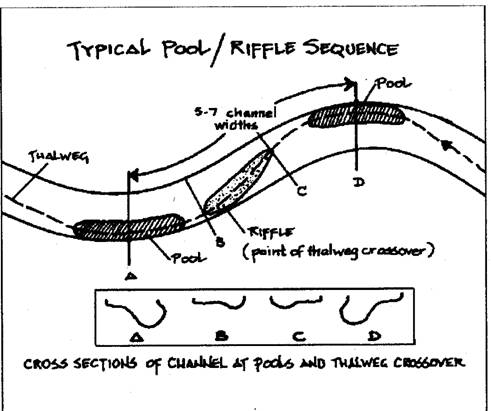
The illustration below shows a typical pool/riffle sequence
|
 |
If the stream is flowing
over a mix of sand, gravel, or cobble (glacial till),
it will form a nicely shaped channel.
The pools occur at intervals in the river, spaced
5 to 7 times the width of the river channel.
Over other kinds of stream bottoms, such as sand or
boulders, the pattern is not as clear.
|
When the
water is streaming, on the outside of a bend, the water
is actually higher on the outside than inside of the turn.
The water falls with gravity, under the main flow, to
dig a pool. The heaviest material is dropped first, then
gravel to build the head of a riffle, then silt and sand
are deposited on the inside of the bend. Essentially at
this point, the flow of the water is sorting the bottom
material by size.
In shallow areas along the banks that go dry in low flow,
vegetation, such as reeds, grasses, and willows, begin
to grow. These plants also influence stream structure
by slowing down the flow of high water running through
them and by collecting debris, silt, and sand which build
up the banks at these points, narrowing the stream. The
roots stabilize the banks so as the water goes around
a bend it digs down and under, creating deeper pools and
undercut banks.
Logs falling in the stream often catch at the end of a
riffle or the beginning of a pool because the flow of
the water is slower here. These logs alter the stream
bottom to giving the gravels of the riffle and run a firm
base to pile up keeping it out of the pool. The small
head difference across the log aids in deepening the pools.
Logs and other large debris (called large organic debris
or LOD) are essential in streams to create good pools,
habitat diversity, and cover for fish.
Logs in the streams rot very slowly because they are always
wet. Hardwoods withstand the impact of sand and gravels
and are most commonly found as natural digger logs. Softwoods
usually "pulp" quickly and are gone in a couple of years.
Therefore, hardwood debris is very important in streams.
Three general terms are used to define the basic types
of stream channels:.
Straight: Applies
to sections or reaches of rivers that are relatively straight
over a long distance. Such reaches are generally unstable.
Even though the channel is straight, the water still bounces
back and forth as it travels down the channel.
Braided: Applies to
sections that have poorly defined, unstable and steep
banks, and shallow watercourse with many channels around
small islands. Too much sediment coming from tributaries
or the crumbling, eroded banks often create the islands.
Meandering:
Applies to sections with a single channel that has many
bends, or "meanders", giving an "S" shaped pattern.
A stream will always attempt to maintain its meander shape
and pattern. This curving pattern is formed by the water
flood flows and is the pattern which is in balance with
the substrate and banks to form a stable stream. Even
when a stream channel appears straight, the line of its
deepest point (thalweg) meanders back and forth across
the channel in a predictable pattern.
You may wonder what the meandering of a stream has to
do with adopting it. It is important to stress at this
point that you will be working with a natural system that
has its own natural patterns. In the Adopt-A-Stream program
we are trying to work with a natural system and help it
repair itself. If you don't understand the "natural flow"
of the stream you are working on, you might end up working
against nature, instead of with it. |
|
When
obstructions in a stream cause it to depart from the
normal meander shape, the stream will always tend to
try to get back to its natural meandering. |
Here
are some general principles that will help you understand
a stream's meandering:
- The width of the stream and the length of the curves
or meanders are closely related. If you imagine that a
meander is a piece of string that you can straighten out,
the length of the curve would be about 5-7 times larger
than the width of the stream.
- When unstable stream banks become reinforced with rocks
or plants the stream will tend to deepen and become more
stable. At any given time streams are carrying all kinds
of different materials such as particles of earth, plants,
and debris. The way these materials are moved around and
dropped off at various points affects a stream's shape
and structure.
- When you look at a stream you probably think of the
water as flowing in one direction. Actually, as water
moves downstream it is also moving back and forth across
the channel. This back and forth movement causes materials
(like silt and sand) to be deposited or dropped at the
inside of a curve, which creates a point bar. Floating
debris builds up on the outside of the curve. For example,
if a log or boulder were put on the inside bank of a curve,
the structure would become buried. In your stream there
may be need to help nature by strategically placing something
that will improve fish habitat. This is covered in later
sections of the manual and a habitat professional will
help you decide on these locations.
- The physical structure of a stream and the quality of
the water flowing in it creates a habitat or home to many
forms of life. The illustration on the next page shows
how a naturally shaped stream gives more useful living
space. Making a stream straighter can dramatically alter
the amount of useful space for fish and other wildlife.
|
|
|


|
|
|
|