|
Introduction
Lakes, ponds, and stillwaters (small
bodies of water with shallow bottoms where rooted plants are
able to grow around the edges) provide habitats for many species
of fish and wildlife.
|
These productive areas can
dramatically improve the habitat of streams and rivers that
flow out of them.
After looking at ponds and lakes we will discuss briefly the
different kinds of stillwater habitats including bogs, fens,
marshes, and swamps. |
Remember that
water systems are interconnected. Something done in or near
a river can affect the lake it flows into. What's done in or
near a lake or marsh can affect the stream flowing out of it.
|
| 4.1.
Lakes
The previous section talked about streams. Streams are basically
a flow-through pattern where productivity depends on the plant
material that is the basis of the food chain. Lakes and ponds
are relatively quiet water by nature. While some of the plant
nutrients in a lake will gradually move downstream, a larger
portion will circulate in food chains within the lake itself.
The species that live in the lake or pond are dependent on
the overall balance of nutrients cycling from organic material,
seasonal temperatures, amount of available oxygen, and light.
|
|
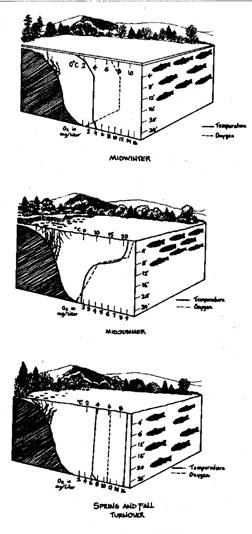
In the spring, a lake is the same temperature
top to bottom (approx. 4 degrees C). At this temperature,
water is at its heaviest. As the summer progresses, the surface
water warms and becomes lighter than the cooler bottom water.
This prevents further mixing. Plants quickly use up nutrients
in the surface water. Plant growth continues in the warm surface
water until the phosphorus it requires runs out. As plants
die, they sink to the bottom and decay. The cooler bottom
water is rich in nutrients, which do not mix with the surface
water because of the difference in densities. The warmth of
surface water is affected by the heat of the summer and the
amount of plant material growing at or near the surface.
|
Trout and land-locked salmon prefer
cool water with a good oxygen supply so they do well in nutrient-poor
lakes.
In lakes with more nutrients their habitats are lost because
they can't find cool water with oxygen.
Other species such as white sucker, smallmouth bass, white
and yellow perch thrive in nutrient-rich lakes because they
prefer warmer surface waters.
|
|
Generally lakes in Nova Scotia, shallower than 3 m if the
water is tea-oloured, and 6m if the water is colourless, become
too warm in the summer for salmonid production. Lakes deeper
than 3m for tea-cloured water and 6m for clourless water,
keep enough cool waterin the bottom for salmonids. If the
input of organic materials or nutrients to the lake are high,
there is the risk that oxygen will become depleted in the
cool water and the fish will have to leave. This has become
a serious problem in Nova Scotia. Additional organic loading
has come from the streams draining into the lakes. If a stream
has good physical structure with un-embedded substrates the
leaf fall is captured in the interstitial spaces and pools.
These organics are processed by the bacteria and insects in
the stream and cycle through the stream's food web. As the
stream structure has collapsed, the organics the stream used
to process now collect in lake bottom to decay and further
deplete the oxygen. Increased nutrient runoff from the land
due to poor forestry and farming practices and all urban development
have place additional loads on the lakes robbing the bottom
waters of vital oxygen. Best management practices can prevent
the problems but this requires a lot of public education and
awareness to change day-to-day practices and changes in the
way we design housing developments. .
In the fall, surface water cools, becoming denser. Eventually
it becomes the same density or heavier than the bottom water
and the waters change places. This is called fall turnover
when nutrients are once again cycled to the top.
As winter progresses, surface water cools below 4 degrees
C. and becomes lighter than the bottom water. Trout and salmon
prefer this warmer bottom water in the winter. However, again
decaying material on the bottom often uses up oxygen and fish
kills frequently occur under the winter ice because of lack
of oxygen.
If a lake or stream requires lime because of low levels of
pH, lime is often placed on the ice and mixes with the lake
water when the lake turns over. The pH in our lakes often
increases with depth so be sure to do a pH profile of the
water column before deciding on the acidity of the lake.
|
As the lake warms in the spring, the
cycle repeats itself. This turnover is illustrated in the figure
to the right.
Lakes can be divided into three categories depending on how
many nutrients they have cycling through their systems. The
amount of nutrients affects a lake's temperature, oxygen levels,
and light supply.
1. A nutrient-poor lake (oligotrophic) is a lake that is poorly
fed, has little phytoplankton (small microscopic plants) or
algae growth. It is usually the coolest lake with depths where
aquatic plants can't root, and fewer productive shallow areas.
Low nutrient lakes have little build-up of decaying organic
material on the bottom so the oxygen isn't used up. These are
ideal for land-locked salmon and all trout species.
2. A moderately nutrient-rich lake (mesotrophic) is moderately
fed and moderately cool. Such lakes are often too warm at the
surface for salmonids. Their survival in these lakes depends
on how much oxygen remains in the cooler bottom water. Warmer
water species such as yellow perch and smallmouth bass can be
found in these lakes.
3. A nutrient-rich or well-fed (eutrophic) lake is the warmest.
Such lakes have very little oxygen in the cool bottom water
and usually you can only find warm water species of fish. Or
a few salmon and trout along the bottom of the warm water where
they is still enough oxygen The more phytoplankton a lake has
the quicker it warms up since the water is darker and absorbs
more of the sun's heat.
As the amount of plant material increases and water temperature
warms up the, the amount of available oxygen decreases. Warm
water can not dissolve as much oxygen as cold water. |
|
The clearness or clarity
of the water also affects how much light can reach plants. Light
doesn't travel through silty, muddy lakes as well as it does
through clean, clear water. Plant production influences insect
production, which in turn affects fish populations. All of these
factors are delicately linked and a small change can create
changes in many areas.
As lakes age, they naturally collect more and more nutrients
and organic materials. This is a natural process that takes
place over time (tens of thousands of years). Human activities
in the watershed (industrial, commercial, residential development,
agriculture, forestry) often cause siltation and release of
excess chemicals and/or nutrients (fertilizers, pesticides,
road salt, hydrocarbons, household and industrial detergents,
sewage and manure). As a lake builds up more plant material,
it warms up and loses oxygen in the bottom water. This causes
a shift in the kind of fish you would find. Trout and salmon
may disappear; with a shift to fish that prefer warmer water.
There are basically four types of habitats in lakes of Nova
Scotia:
1. Sandy, Sheltered Shores: People prefer sandy shores but these
are the least productive areas ecologically. The sand is constantly
shifting, making it difficult for plants to grow; creating a
weak food web.
2. Exposed Shores: The wave action here keeps the bottom clean
of silt and sand so food chains are similar to streams. You
can find some of the same stream insects (caddisfly, mayfly)
on the rocks along exposed shores. Other zones in the lake
3. Profundal Zone (Littoral zone):The area around the edge of
the lake where light reaches the bottom; includes sheltered
and exposed shores. In areas where many plants are produced,
many insects form the basis of a food chain. Small minnows or
lake chub are often seen in groups but this area can also be
feeding grounds for trout. Landlocked salmon, trout, and bass
will feed here, often at dusk when they can use the low light
conditions and plants for cover.
4. Open Water: The open water habitat of the lake was basically
described earlier at the beginning of this section when we talked
about lake temperatures at different times of the year. The
open part of a lake is less productive than the littoral zone
|
| |
|


|
|
|
|